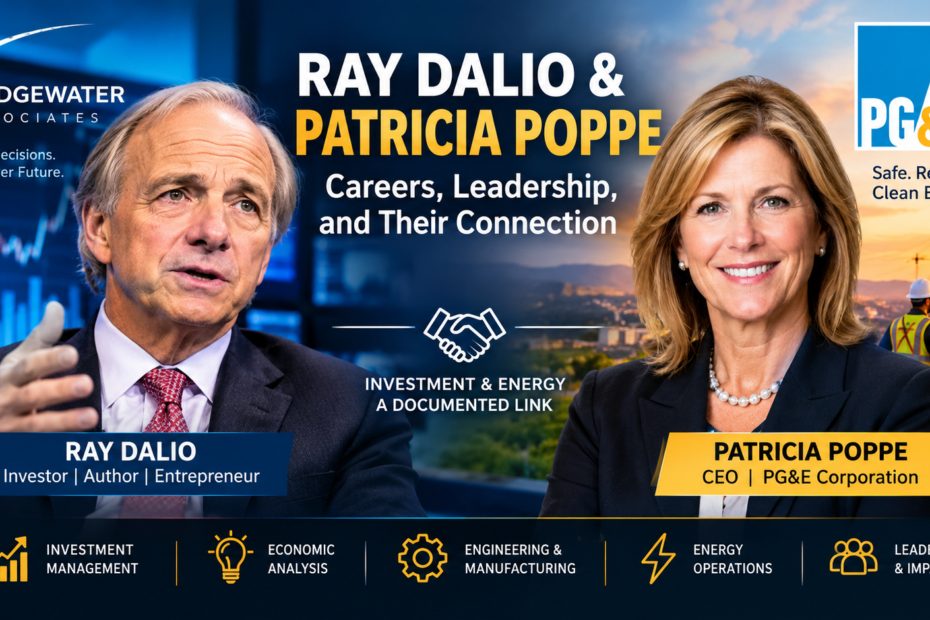
Ray Dalio and Patricia Poppe built their careers in different parts of the American business world. Dalio became known for investment management and economic analysis, while Poppe developed her expertise in engineering, manufacturing, and energy operations.
Dalio founded Bridgewater Associates in 1975 and helped develop its investment philosophy over several decades. Poppe, also known as Patti Poppe, became CEO of PG&E Corporation in January 2021 after leading CMS Energy and its principal subsidiary, Consumers Energy.
Their names have also appeared together in articles discussing investment activity and corporate leadership. One documented link involves Bridgewater Associates’ reported investment in PG&E Corporation. However, that institutional connection does not prove that Dalio and Poppe have a personal relationship or direct business partnership.
Understanding their individual careers and the evidence behind this connection helps readers separate verified information from speculation.
Who Are Ray Dalio and Patricia Poppe?
Ray Dalio is an American investor, entrepreneur, and author. He established Bridgewater Associates, which became a major institutional investment management firm known for its global macro approach.
Patricia Poppe is an American business executive with a background in industrial engineering and energy operations. She previously held leadership positions at General Motors, DTE Energy, CMS Energy, and Consumers Energy before joining PG&E Corporation.
Their professional backgrounds differ, but both have worked in complex environments where decisions can affect organizations, employees, customers, and financial outcomes.
| Profile detail | Ray Dalio | Patricia Poppe |
|---|---|---|
| Professional field | Investment management | Energy and utilities |
| Best known for | Founding Bridgewater Associates | Leading PG&E Corporation |
| Education | Long Island University and Harvard Business School | Purdue University and Stanford Graduate School of Business |
| Career background | Financial markets and economic research | Engineering, manufacturing, and energy operations |
| Leadership focus | Investment principles and risk management | Safety, infrastructure, and customer service |
| Public recognition | Investor, author, and economic commentator | Corporate executive and energy-sector leader |
This comparison provides a starting point for understanding their careers without suggesting that they share the same professional responsibilities.
Ray Dalio: The Journey Behind Bridgewater Associates
Early Interest in Investing
Ray Dalio developed an interest in financial markets at an early age. At 12, he purchased shares of Northeast Airlines using money he had earned as a golf caddie.
The investment helped introduce him to the opportunities and uncertainties of the stock market. His early experience encouraged him to learn more about how financial markets respond to economic conditions and investor expectations.
Dalio studied finance at what is now Long Island University before earning an MBA from Harvard Business School in 1973. He then gained experience in the financial industry before establishing his own business.
Founding Bridgewater Associates
Dalio founded Bridgewater Associates in 1975 from his two-bedroom apartment in New York City. The firm initially focused on market research, economic commentary, and financial advice.
Over time, it developed into an institutional investment manager serving major clients. Its work became associated with global macro investing, which examines broad economic forces rather than concentrating exclusively on individual companies.
These forces include inflation, interest rates, economic growth, currency movements, and government policies. By examining how these factors interact, investors can develop a clearer understanding of potential risks and opportunities.
Bridgewater’s growth helped establish Dalio as an influential figure in the investment industry. His approach also placed considerable emphasis on testing ideas, studying historical patterns, and evaluating the assumptions behind financial decisions.
What Is the All Weather Strategy?
One of the investment approaches associated with Dalio and Bridgewater is the All Weather strategy, introduced in 1996.
The strategy addresses a common challenge in portfolio management: investments that appear diversified may still depend heavily on one particular economic environment.
For example, some assets may benefit from economic growth but struggle during a recession. Other investments may respond differently when inflation rises or interest rates change.
The All Weather approach seeks to balance portfolio risk across different economic conditions. Rather than relying entirely on a single forecast, it considers how investments may behave under different circumstances.
However, diversification cannot eliminate every risk. Financial markets can behave unexpectedly, and no investment strategy guarantees profits or prevents losses.
Books and Leadership Principles
Dalio has also shared his ideas through books, interviews, and educational projects.
His best-known book, Principles: Life and Work, discusses decision-making, organizational culture, learning from mistakes, and personal development. Other notable works include Principles for Dealing with the Changing World Order and Principles for Navigating Big Debt Crises.
A recurring theme in his writing is the importance of examining evidence rather than relying solely on assumptions. He also advocates for open debate, direct feedback, and the development of clear principles that guide decisions.
These ideas have influenced discussions about business management and workplace culture. Still, they represent Dalio’s approach to leadership rather than universal rules for success.
Dalio’s Transition Away From Bridgewater Leadership
Understanding Dalio’s current status is important when discussing the company he founded.
He stepped down as CEO in 2017, left the CIO role in the summer of 2020, and stepped down as chairman at the end of 2021. Bridgewater subsequently continued its transition toward a broader leadership and ownership structure.
In July 2025, Reuters reported that Dalio had sold his remaining ownership stake in Bridgewater Associates. The report also said he would leave the firm’s board.
His legacy as Bridgewater’s founder remains significant. However, his former leadership and ownership positions should not be confused with the firm’s present management or every investment decision it makes.
Patricia Poppe: From Engineering to Energy Leadership
Education and Early Professional Experience
Patricia Poppe built her career through engineering, manufacturing, and operational management.
She earned bachelor’s and master’s degrees in industrial engineering from Purdue University. She later completed a master’s degree in management at Stanford Graduate School of Business.
Poppe began her career in the automotive industry at General Motors, where she held plant management positions. This experience exposed her to manufacturing systems, production processes, workforce coordination, and operational efficiency.
She later joined DTE Energy and served as a power plant director. Moving into the energy sector expanded her experience in infrastructure, electricity generation, and industrial operations.
Leadership at CMS Energy and Consumers Energy
Poppe subsequently joined CMS Energy, where she held several leadership positions involving engineering, distribution operations, customer experience, and regulatory matters.
In 2016, she became president and CEO of CMS Energy and its principal subsidiary, Consumers Energy. These responsibilities involved overseeing utility operations, customer service, infrastructure, and business performance.
Her experience in Michigan prepared her for a senior leadership role at a larger utility organization. It also gave her experience balancing operational priorities with customer needs and regulatory requirements.
Becoming CEO of PG&E Corporation
PG&E Corporation appointed Poppe as CEO effective January 4, 2021. She also serves on the boards of PG&E Corporation and its utility subsidiary, Pacific Gas and Electric Company.
PG&E operates in California, where energy providers face substantial responsibilities involving service reliability, infrastructure investment, wildfire risks, and the changing needs of electricity customers.
The company serves approximately 16 million people across Northern and Central California. Its work requires coordination among engineers, field employees, regulators, customers, and emergency-response organizations.
Poppe’s stated leadership priorities include improving operational performance, strengthening safety practices, reducing waste, and rebuilding customer trust.
These goals matter because utility companies provide essential services. Their performance affects households, businesses, public infrastructure, and local communities.
Assessing executive performance requires more than reviewing a company’s stated priorities. Reliable evaluations also consider measurable safety outcomes, service reliability, financial results, and progress on infrastructure improvements.
What Connects Ray Dalio and Patricia Poppe?
The Bridgewater–PG&E Investment Connection
The clearest documented institutional link between their professional worlds involves Bridgewater Associates and PG&E Corporation.
Bridgewater’s Form 13F filing for the quarter ending June 30, 2026, reported 5,931,314 shares of PG&E Corporation, with a market value of approximately $99.8 million at the reporting date.
This filing provides a concrete reason to examine the two organizations together. Dalio founded Bridgewater, while Poppe leads PG&E Corporation.
However, the relationship between the organizations should not be mistaken for proof of a direct relationship between their associated executives.
What Does the SEC Filing Actually Prove?
A Form 13F is a regulatory report that institutional investment managers file to disclose certain securities over which they exercise investment discretion.
The report records positions at a specific reporting date. It does not necessarily reveal the full investment rationale, identify every person involved in a decision, or establish a personal relationship between the manager and the company whose shares appear in the filing.
The timing also matters. Dalio sold his remaining ownership stake in Bridgewater in 2025, while the reported PG&E position relates to June 30, 2026.
For this reason, the accurate statement is that Bridgewater Associates reported a position in PG&E Corporation. The filing does not establish that Dalio personally purchased the shares or selected the investment.
Are They Business Partners?
The documented information discussed here does not establish that Dalio and Poppe are direct business partners, personal associates, or collaborators.
Their names appear together in business coverage because of the institutional link between Bridgewater and PG&E. That connection is relevant, but it does not justify claims about meetings, agreements, or private discussions that reliable evidence has not established.
This distinction is particularly important when reading online articles that place two prominent business figures in the same headline. A shared business topic does not necessarily mean the individuals have worked together.
Why the Connection Matters to Business Readers
The connection illustrates how investment management and the energy sector can intersect.
Investment firms evaluate companies across a wide range of industries, including utilities. Meanwhile, utility providers require substantial funding to maintain equipment, modernize infrastructure, improve service reliability, and respond to regulatory requirements.
A reported institutional holding can therefore interest readers studying financial markets and the energy industry. However, one filing cannot explain the manager’s entire strategy, predict future stock performance, or demonstrate an endorsement of the company’s leadership.
Readers should consider the reporting date, the nature of the disclosure, and the limits of the available evidence before drawing conclusions.
Comparing Their Leadership Approaches
Although Dalio and Poppe work in different industries, their careers illustrate different ways of managing complex organizations.
Ray Dalio: Analysis and Investment Risk
Dalio’s public philosophy emphasizes evidence, economic patterns, risk assessment, and learning from mistakes.
Investment management involves uncertainty. Economic conditions can change quickly, and decisions that appear reasonable at one point may produce unexpected results later.
Dalio’s approach encourages investors to examine assumptions, consider different outcomes, and develop systematic ways to evaluate risk.
Patricia Poppe: Operations and Public Responsibility
Poppe’s career focuses on engineering, energy infrastructure, organizational execution, and utility operations.
Her responsibilities involve maintaining systems, coordinating employees, improving safety, and delivering reliable service. These tasks require practical planning and accountability across a large organization.
Utility leadership also involves public responsibilities. Operational problems can affect communities directly, which makes safety and reliability central to evaluating performance.
Lessons From Their Careers
Their experiences offer several useful lessons for business readers:
- Use reliable information. Evidence helps decision-makers separate established facts from assumptions.
- Understand risk. Different industries face different risks, but both investment managers and utility executives must prepare for uncertainty.
- Learn from experience. Reviewing mistakes can reveal weaknesses and support better decisions.
- Build effective systems. Clear processes help organizations manage complicated responsibilities.
- Measure results. Leadership claims become more meaningful when supported by verifiable outcomes.
- Avoid unsupported conclusions. Corporate filings and official biographies establish specific facts, but they do not automatically reveal personal motives or relationships.
These lessons provide a more useful comparison than suggesting that the two executives have identical goals or a direct partnership.
Frequently Asked Questions
1. Who is Ray Dalio?
Ray Dalio is an American investor, author, and entrepreneur who founded Bridgewater Associates in 1975. He is known for global macro investing, economic analysis, risk management, and his books about decision-making.
2. Who is Patricia Poppe?
Patricia Poppe, commonly known as Patti Poppe, is an American business executive who became CEO of PG&E Corporation in January 2021. Her professional background includes engineering, manufacturing, and energy operations.
3. What is the connection between Ray Dalio and Patricia Poppe?
The documented institutional connection involves Bridgewater Associates and PG&E Corporation. Bridgewater reported a position in PG&E shares in its second-quarter 2026 filing. This does not establish a direct personal or business relationship between Dalio and Poppe.
4. Did Ray Dalio personally buy PG&E shares in 2026?
The cited filing reports a Bridgewater Associates position. It does not establish that Dalio personally purchased the shares or made the investment decision.
5. Does Ray Dalio still own Bridgewater Associates?
Reuters reported in July 2025 that Dalio sold his remaining ownership stake in Bridgewater Associates. He remains known as the firm’s founder, but his historical role should be distinguished from its current ownership and management.
6. What does Patricia Poppe do at PG&E?
Poppe serves as CEO of PG&E Corporation and sits on the boards of PG&E Corporation and Pacific Gas and Electric Company. Her responsibilities involve corporate leadership in the energy sector, including safety, operational performance, infrastructure, and customer service.
7. What is Ray Dalio best known for?
Dalio is best known for founding Bridgewater Associates and developing influential approaches to investment research and risk management. He is also recognized for the All Weather strategy and his books on economic cycles and decision-making.
8. What did Patricia Poppe study?
Poppe earned bachelor’s and master’s degrees in industrial engineering from Purdue University. She also earned a master’s degree in management from Stanford Graduate School of Business.
9. Do Ray Dalio and Patricia Poppe work in the same industry?
No. Dalio’s career centers on investment management and financial markets, while Poppe’s career focuses on engineering, energy operations, and utility leadership.
10. Why should readers verify claims about their connection?
Verification helps readers distinguish documented corporate activity from speculation. An institutional investment filing can establish a reported holding, but it does not automatically prove a personal investment, business partnership, or direct relationship between executives.
Final Thoughts
Ray Dalio and Patricia Poppe built their careers through different forms of leadership. Dalio founded Bridgewater Associates and became known for his work in investment management, economic analysis, and risk assessment. Poppe advanced through engineering, manufacturing, and energy operations before becoming CEO of PG&E Corporation.
Bridgewater’s reported PG&E shareholding provides a documented institutional link between their professional worlds. However, it does not prove a personal partnership or establish that Dalio personally made the investment decision. Click here for more information.
For readers interested in these business figures, the most useful approach is to examine their actual responsibilities, career histories, and verifiable records. Separating confirmed facts from assumptions provides a clearer and more trustworthy understanding of both leaders.