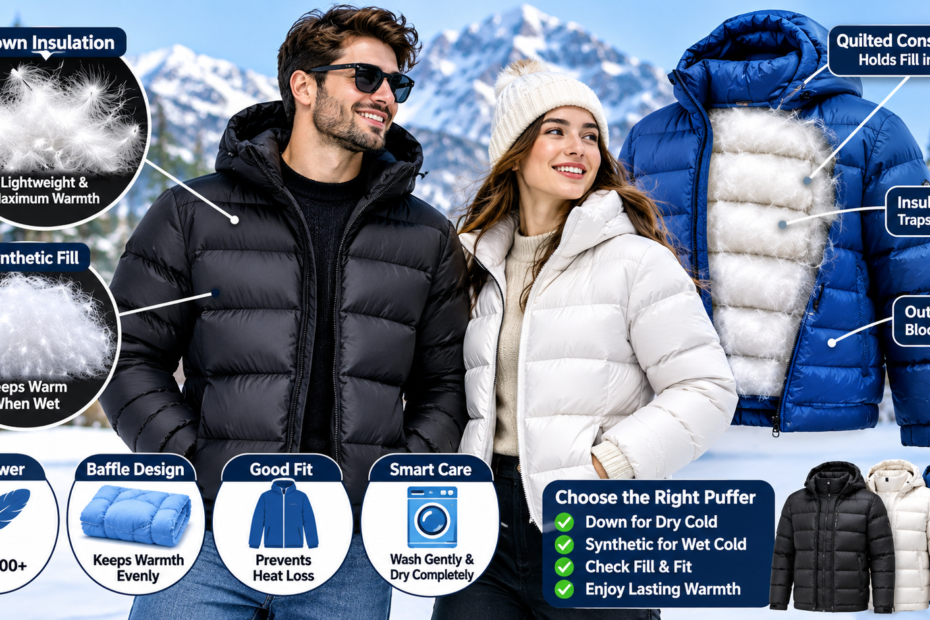
dA puffer looks like a pile of fluff in stitched rows. Yet each row has a job. Knowing how puffer jackets work helps you read a tag, compare two coats, and pick one that fits your winter. This guide covers the insulation, the quilting, and the details that decide how warm a jacket really feels.
How Puffer Jackets Work
A puffer does not make heat. It holds the heat your body already gives off. The fill traps tiny pockets of still air, and still air moves heat slowly. Your body warms that air, and the jacket keeps it close.
Three parts do the work. The outer shell blocks wind and light moisture. The fill traps air. The lining sits against your clothes and keeps the fill in place.
Loft matters most. Loft is how much the fill puffs up. More loft means more trapped air, which means more warmth. When fill gets crushed or soaked, loft drops and so does the heat.
Puffer Jacket Insulation Types
Puffer jacket insulation types fall into two main groups: natural down and synthetic fill. A few hybrid builds mix both.
Down is the soft layer under the outer feathers of ducks and geese. It forms light clusters that trap a lot of air. Synthetic fill uses fine polyester fibers that copy that effect. Some makers also use recycled fibers or plant-based fills, though these are still a smaller share of the market.
Each type suits a different climate. The next two sections break down how they differ.
Down vs Synthetic Insulation
Down vs synthetic insulation is the biggest choice you will make. own gives the best warmth for its weight. It also packs small and lasts for many years with good care. Its weakness is water. Wet down clumps and loses loft, and it dries slowly.
Synthetic fill keeps working when damp. It dries faster, costs less, and suits people who avoid animal products. It runs heavier and bulkier for the same warmth, and it loses loft sooner over time.
Dry, cold places favor down. Wet, cold places favor synthetic. Many city shoppers choose synthetic for its easy care. Many hikers and travelers choose down for its low weight.
Some brands now treat it with a water-repellent finish. That helps in light snow, but it does not make it waterproof.
Winter Jacket Filling Materials
Winter jacket filling materials come with ratings that are worth learning. Down is graded by fill power, which measures how much space one ounce of down fills. A rating around 550 to 650 is solid for everyday coats. A rating of 700 or more suits serious cold and light, packable designs.
You will also see a down-to-feather ratio, such as 90/10. The first number is the share of down. The rest are small feathers, which add weight but little warmth. Higher down content usually means better quality.
Synthetic fill is rated by weight, often in grams per square meter. A 60-gram fill suits cool days. A 200-gram fill suits deep winter. Higher numbers mean more insulation.
Fill weight also counts. A jacket with high fill power but little fill may feel thin. A jacket with moderate fill power and plenty of fill can feel very warm, though it will weigh more.
Quilted Jacket Construction
Quilted jacket construction is what gives a puffer its shape. Makers sew the shell and lining together in rows or boxes called baffles. Each baffle holds a set amount of fill so it cannot slide to the bottom of the coat.
Workers blow the fill into each chamber through a small opening, then close it. This takes care. Uneven filling leaves cold spots.
There are two common methods. Sewn-through construction stitches straight through the shell and lining. It is light and simple, but heat can leak along the stitch lines. Box-wall construction adds thin fabric walls between the shell and lining. The fill gets more room to loft, and cold spots shrink. It costs more to make.
Baffle size changes the look. Narrow baffles give a slim, sleek shape. Wide ones give a bolder, rounder look and more loft in each chamber.
Puffer Jacket Warmth Factors
Puffer jacket warmth factors go beyond the fill itself. Fit is first. A jacket that is too tight squeezes the fill flat. One that is too loose lets cold air circulate. You want room for a sweater without crushing the loft.
The shell fabric matters. A tightly woven nylon or polyester blocks wind, which strips heat fast. A thin, loose shell lets wind through and cuts warmth.
Details at the openings count. Elastic cuffs, a snug hem, and a high collar seal in heat. A hood adds a lot of warmth for little weight. Insulated pockets keep hands warm.
Length also helps. A hip-length puffer covers most daily needs. A knee-length coat holds more heat for standing around in a deep cold.
For a plain, easy-to-match option, many shoppers start with a Black Puffer Jacket because it hides dirt and works with most outfits.
Choosing a Puffer for Your Climate
Start with the weather you face most. For dry cold, pick down with a decent fill power. for a damp cold, pick synthetic or a hybrid. For mild winters, a light puffer or a vest works well, especially under a shell.
Think about your day. If you walk or commute, a mid-weight jacket handles most trips. If you stand outside for long stretches, add loft and length.
Color is a matter of use. Dark shades hide wear. Pale ones brighten gray winter days. A white puffer jacket looks sharp with denim or dark knits, though it needs a bit more cleaning.
How to Care for Puffer Jackets
How to care for puffer jackets starts with the care label. Most can go in a front-loading washer on a gentle cycle. Use a cleaner made for down or technical fabrics. Skip fabric softener, since it coats the fill and cuts loft.
Dry the jacket on low heat. Add two or three clean tennis balls or dryer balls to break up clumps. This step takes patience. A down jacket can need several cycles before the fill feels fully dry and fluffy.
Spot clean small marks with a damp cloth and mild soap. Patch tiny tears right away with repair tape. Feathers can work out through a small hole.
For storage, hang the jacket or keep it loosely folded in a large bag. Do not leave it compressed for months. Crushed fill loses loft over time.
Common Mistakes to Avoid
People often judge warmth by thickness alone. A thick jacket with low-quality fill can be colder than a thin one with high fill power. Another mistake is buying down for a wet climate without a repellent finish.
Many also forget fit. A jacket that looks great but squeezes your sweater flat will not keep you warm. Try it on with the layers you plan to wear.
The Takeaway
How puffer jackets work comes down to trapped air. The fill holds it, the baffles keep the fill in place, and the shell blocks wind. Down gives top warmth for its weight. Synthetics give better results in wet weather.
Check the fill type, fill power, construction, and fit before you buy. Then care for it well, and a good puffer will keep you warm for many winters. Click here for more information.